
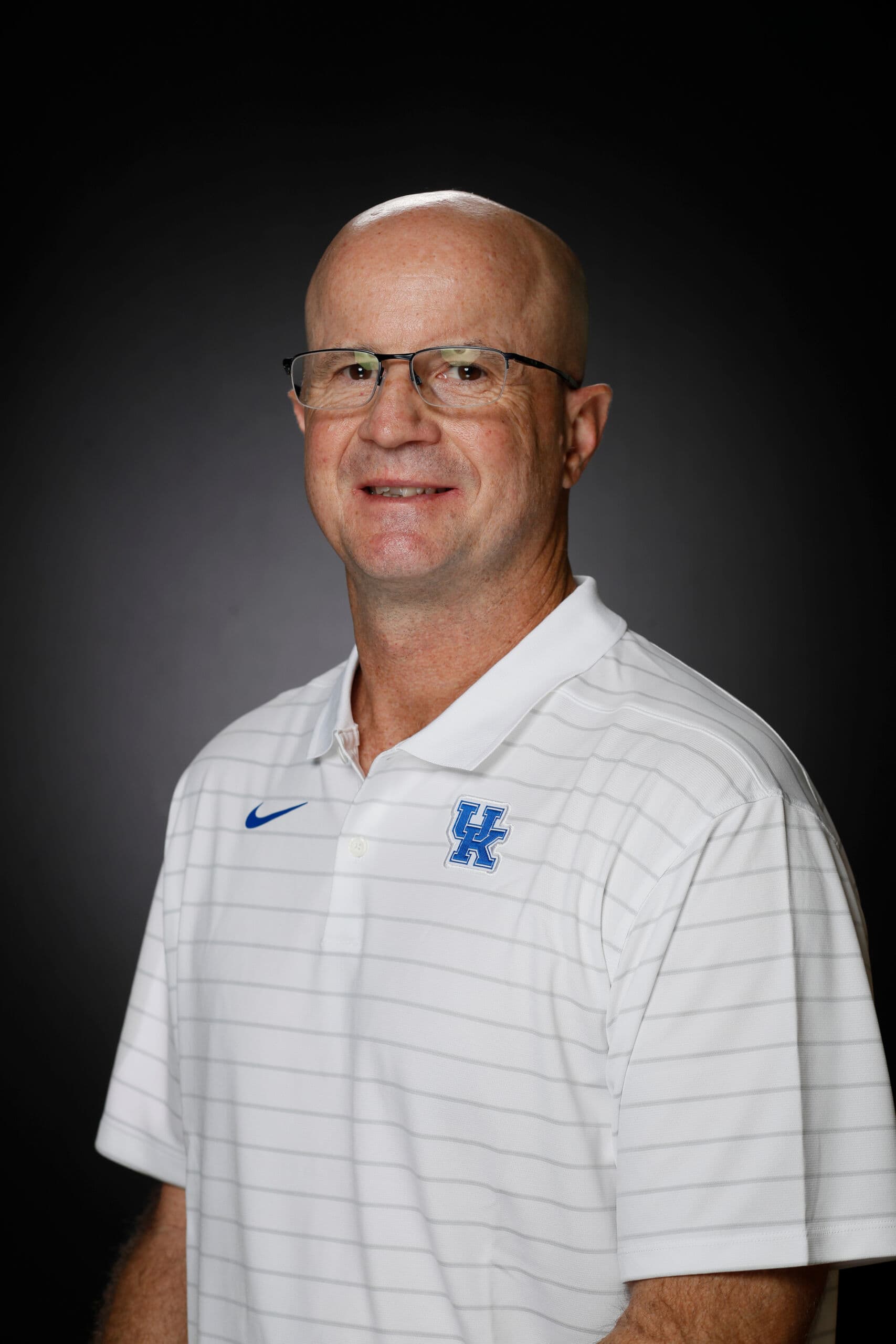
Since being tabbed Kentucky’s head coach in December 2004, Craig Skinner has rejuvenated the Kentucky volleyball program into national prominence and is the program’s all-time winningest head coach. He will enter his 22nd season in 2026 with an all-time record of 497-157.
He reached the pinnacle of the sport in April of 2021, winning the 2020 NCAA National Championship at the CHI Health Center in Omaha, Nebraska, becoming coach of the first volleyball team in Southeastern Conference history to win a national championship. He was named the AVCA’s National Coach of the Year in 2020-21.
Skinner has directed the Wildcats to twenty-one consecutive NCAA Tournaments – a feat only eight other schools in the nation have achieved. That run includes eleven Sweet Sixteen appearances since 2009, four Elite Eight appearances, the 2020 and 2025 NCAA Final Four’s and back-to-back-to-back-to-back-to-back-to-back-to-back-to-back SEC titles in 2017, 2018, 2019, 2020-21, 2021, 2022, 2023, 2024 and 2025.
Skinner became the fastest coach in school history to total 100 career victories in just his fifth season, and is the only coach in program history to advance to postseason play in each season at the helm. In 2012, Skinner notched his 100th career Southeastern Conference victory. In 2014 Skinner earned his 211th win as the head coach of the Wildcats to become the school’s all-time leader in career wins.
The Wildcats have enjoyed unprecedented success which has included a school-record run of 114 consecutive weeks ranked in the top 25 of the American Volleyball Coaches Association poll, record-breaking attendance marks and a 11-time host of NCAA Tournament play including serving as one of four host sites for the 2017, 2015, 2013 and 2011 NCAA Regionals.
In just one season in the Bluegrass, Skinner led the Wildcats to a 17-12 record and their first appearance in the NCAA Tournament since 1993. For the team’s accomplishments and quick turn-around, Skinner was named the 2005 SEC Coach of the Year.
In addition to Skinner’s success at Kentucky, he was selected as the head coach of the 2006 U.S. Junior Women’s National Team. Skinner led the team to the gold medal in the 2006 Under-20 NORCECA Championships. Prior to joining the Wildcats, Skinner spent five seasons as an assistant at Nebraska under John Cook and was named head assistant coach in 2003.
A native of Muncie, Indiana, Skinner spent three seasons as an assistant coach under Cook at Wisconsin. Skinner returned to his alma mater in 1999, helping guide the Ball State men to wins over three nationally ranked teams and an 8-4 record at midseason in 2000 before leaving for Nebraska. That team finished the season ranked 13th in the USA Today/AVCA Top 25.
Skinner is married to former Nebraska assistant women’s soccer coach Megan Bechtold Skinner. The couple has two daughters, Sophie and Isabel, and a son, Eli.
Rotary in Review
“CHAMPIONSHIP LEVEL IS A CHOICE”
Craig Skinner, the architect and coach of the highly successful University of Kentucky women’s volleyball program, spoke to Rotary on Thursday, January 22, 2026. He talked about what it took to build the program to its current position of national prominence, and what it takes to maintain that standard. In short, he “strongly believe[s] that a championship level is a choice.”
Although the leader of the program, he sees himself as simply one of many who are crucial to the success that has been achieved: “It’s not Craig Skinner’s program, it’s Kentucky volleyball.” A notable quality of this highly accomplished coach is that he believes everyone, regardless of their role, is valuable. His philosophy as to the team members is that “we recruited all of them” and we will faithfully “coach all of them,” whether a starter or a bit role player.
He sees his own role as that of teacher, leader, and mentor, and the fulfillment of that role as primarily threefold: Developing people, decision making, and leadership philosophy. As to the first element, he asks himself how he can help people develop to the fullest extent of their capabilities. This includes understanding the specific role each player and each of the staff can best fulfill based upon their talents and current level of development.
The decision-making element has been a bigger part of his role as head coach than what he had realized as an assistant, and consumes much of his time. As to the last element, the question is what leadership philosophy can best result in a championship level of program performance while achieving buy-in from the program’s constituents? He understands the latter will involve some modifications to coaching and leadership style as personnel changes occur, but shuns any modifications that would sacrifice fundamental ethics and principles.
The Kentucky program under Coach Skinner is designed to challenge its players, because “champions recognize that they need to be challenged, they don’t feel like they have already arrived.” At the level of competition faced by UK, talent is simply the starting line and must be accompanied by the work and planning necessary to maximize the output from that talent. But the challenges are not limited to the volleyball court; rather, they extend to excelling in the classroom and to making the right decisions socially and in all other aspects of life. The attention to the non-volleyball aspects demonstrates to the players that the coaching staff truly care about them as people, not just as athletes.
Another important element of Coach Skinner’s philosophy is to teach players to think for themselves. The coaching staff cannot be on the floor with the players, and they cannot anticipate and coach-up every situation that may face the players. By letting the players learn to think through things for themselves, they will develop the ability to quickly and accurately assess and react to the varied situations that will arise during a match.
At its core, while operating and achieving at the highest of NCAA levels, the Kentucky volleyball program is about more than wins and losses as tallied by on-court scores. It is about the wins that come from developing young athletes into young leaders and teammates who excel on and off the court.
– Louis Hatcher