
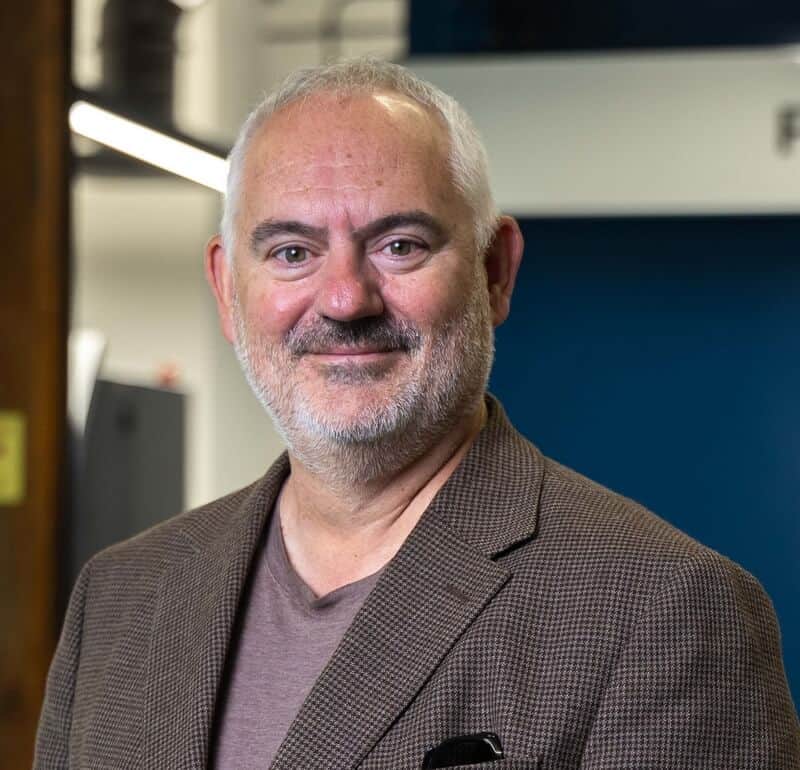
When we think of archaeology, we often conjure the image of Indiana Jones in a jungle temple or desert tomb. What if, instead, we see a man at a computer in a lab using high technology to recover the secrets of the past? That is exactly what Dr. Brent Seales does. He has recovered artifacts and information thought last forever. Imagine reading a 1700 year old bible or a 2000 year old scroll or seeing carvings on monoliths hundreds of years old. Brent has and is sharing these treasures with the world.
Dr. Seales has been teaching and mentoring students in computer science at the University of Kentucky since 1991. The focus of his research for the past twenty years has been on restoring and redeeming cultural and historical artifacts from the ravages of time. The challenge of rescuing texts that may be central to Biblical scholarship and the formation of the ancient world is a primary passion.
As a result of his innovations, Dr. Seales has become renowned by collectors and curators across the globe, earning a reputation as “the guy who can read the unreadable.” His breakthrough work on the scroll from En-Gedi received international recognition and was featured in Science Advances, the New York Times, Le Monde, and the Times of London.
In his presentation today, he will tell the story of virtual unwrapping, conceived during the rise of digital libraries, computer vision, and large-scale computing, and now realized on some of the most difficult and iconic material in the world – the Herculaneum Scrolls – as a result of the recent phenomena of big data and machine learning. Virtual unwrapping is a non-invasive restoration pathway for damaged written material, allowing texts to be read from objects too damaged even to be opened.
Dr. Seales is the Stanley and Karen Pigman Chair of Heritage Science and Professor of Computer Science at the University of Kentucky. He earned a Ph.D. in Computer Science at the University of Wisconsin-Madison and has held research positions at INRIA Sophia-Antipolis, UNC Chapel Hill, Google (Paris), and the Getty Conservation Institute. The Heritage Science research lab (EduceLab) founded by Seales at the University of Kentucky applies techniques in machine learning and data science to the digital restoration of damaged materials.
He continues to work with challenging, damaged material (Herculaneum Scrolls, Dead Sea Scrolls), with notable successes in the scroll from En-Gedi (Leviticus), the Morgan MS M.910 (The Acts of the Apostles), and PHerc.Paris.3 and 4 (Philodemus / Epicureanism). The recovery of readable text from still-unopened material has been hailed worldwide as an astonishing achievement fueled by open scholarship, interdisciplinary collaboration, and extraordinary leadership generosity.
The Editor thanks Eric Brooks for his contributions to this Meet Our Speaker piece.
Rotary in Review
A HERCULEAN EFFORT TO DECODE THE HERCULANEUM SCROLLS
Our speaker two weeks ago was Dr. Brent Seales, the Stanley and Karen Pigman Chair of Heritage Science and Professor of Computer Science at the University of Kentucky. Before he began his presentation, he thanked Rotarian Dr. Tom Lester, Dean Emeritus of the College of Engineering, for granting him tenure. His fascinating program was “On Perseverance: Virtually Unwrapping the Herculaneum Scrolls.” The scrolls date to 79 AD and the day that Herculaneum and the more famous city of Pompeii were destroyed by the eruption of Mt. Vesuvius. While Pompeii was destroyed by lava, the lesser known and closer town was covered with hot mud and noxious gas, entombing the city and its inhabitants. This toxic mixture soon turned into concrete. Seventeen hundred years later British scientists and engineers began excavation of the site, which included Pliny the Elder’s villa, an exact replica of which houses the John Paul Getty Museum of Art in California.
Dr. Seales explained the challenges of unrolling the Herculaneum Scrolls – or any ancient scroll – which would disintegrate upon touching. The rolled layers are also not flat, adding to the difficulty of deciphering the manuscript. The artifact must be digitally flattened by virtually unwrapping the scroll by using a CT Scanner – techniques all developed at the University of Kentucky. By using an engineering approach and technology, a new image or set of images emerges to enhance scholarship. Using volume cartography, the scrolls were discovered to cover subjects such as Rhetoric, Poetry, Music, Free Speech and Argumentation. The English poet, Wordsworth, lamented the fact of trying to unroll one precious scroll, concluding that history cannnot be opened. Three-dimensional scans created cross sections of the manuscripts that could then be internally unwrapped using segmentation and texturing, which created images of the lead or iron ink used.
The difficulty of working with these artifacts was made evident by several replicas of what these manuscripts look like when uncovered that were passed around for Rotarians to handle. They resemble nothing so much as lumps of coal or some other other, similar hard material. Also passed around were photos of what those “lumps” contained after being subjected to the work of Dr. Seales’ team.
Dr. Seales and his team have been able to digitally restore one of the oldest copies of Beowulf and texts that turned out to be the Book of Leviticus found at En Gedi in Jerusalem (where they first proved that the technology and preservation methodology worked). He allowed that his holy grail would be to someday recover a letter from the Apostle Paul. He mentioned that the technology developed at UK has been featured on 60 Minutes and in Le Monde, and the New York Times. The August 2026 National Geographic cover story will be on his team’s research and their herculean efforts to bring the Herculaneum Scrolls and other ancient documents back to life.
– Paul B. Chewning
Recent Updates
Edwin Gibson Honored with Cliff Dochterman Award
Mar. 12 – Robert Mucci, Author, Garvice Kincaid Life and Success
Humanitarian Award Presented to Darlene Thomas, Greenhouse17
Mar. 5 – Tina Nance, Executive Director, Aviation Museum of Kentucky
Rotary Club of Lexington Announces 15th Annual Dancing with the Lexington Stars